Integrated testing of ballastless high-speed railway track designed by Natsproektstroy has started in Kolomna
VNIKTI Research & Development Center (Kolomna) is testing the ballastless track designed by Natsproektstroy for the domestic high-speed railway network. The design is exactly the same as the one that will be used for the first Moscow–St. Petersburg High-Speed Highway.
29 May 2026
Copy link
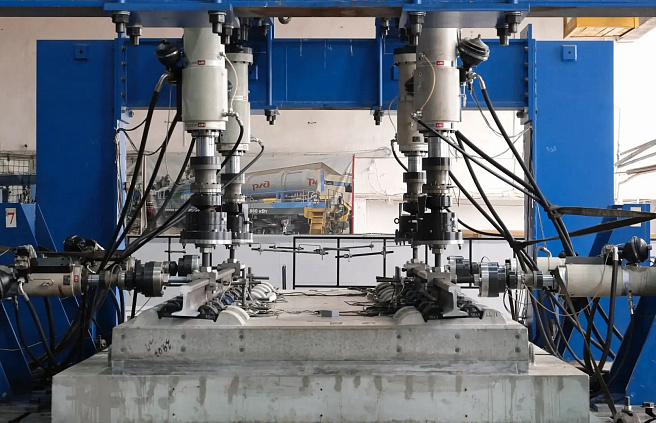
The ballastless high-speed railway track consists of several layers of concrete. A polymer-coated rail slab is laid on the reinforced foundation. A layer of self-compacting concrete is poured between the slab and the foundation.
The rail slab is a key element of the high-speed railway track. It is designed for high dynamic loads at train speeds up to 400 km/h, and a wide temperature range from -50 °C to +50 °C. The design has received a patent for invention and has no counterparts in the world.
The key goal of testing is to comprehensively check the entire track assembly, confirm the safety margin and determine the actual life of key elements before launching mass production.
The tests are conducted on a test bench in an accelerated mode. The structure is simultaneously exposed to eight pulsators: four vertical and four horizontal, which create the effect of interaction of a high-speed train bogie with a rail.
The structure undergoes 9 million loading cycles, which is the equivalent of 50 years of operation. Such testing makes it possible to determine the reliability and durability of all elements of the future high-speed railway track in a short time.
One of the key advantages of the ballastless high-speed railway track design developed by Naptsroektstroy is its maintainability. The polymer coat at the bottom of the rail slab allows it to be separated from the other layers without destroying the entire concrete stack. The track structure was successfully separated after passing through all the loading cycles during testing. This proves that the slab can be replaced and repaired during operation. Due to the highest reliability, the structure can serve for at least half a century without overhaul.
Rail slabs for high-speed railways will be produced at two robotized plants that Natsproektstroy will launch in Novgorod and Tver Regions.
The rail slab is a key element of the high-speed railway track. It is designed for high dynamic loads at train speeds up to 400 km/h, and a wide temperature range from -50 °C to +50 °C. The design has received a patent for invention and has no counterparts in the world.
The key goal of testing is to comprehensively check the entire track assembly, confirm the safety margin and determine the actual life of key elements before launching mass production.
The tests are conducted on a test bench in an accelerated mode. The structure is simultaneously exposed to eight pulsators: four vertical and four horizontal, which create the effect of interaction of a high-speed train bogie with a rail.
The structure undergoes 9 million loading cycles, which is the equivalent of 50 years of operation. Such testing makes it possible to determine the reliability and durability of all elements of the future high-speed railway track in a short time.
One of the key advantages of the ballastless high-speed railway track design developed by Naptsroektstroy is its maintainability. The polymer coat at the bottom of the rail slab allows it to be separated from the other layers without destroying the entire concrete stack. The track structure was successfully separated after passing through all the loading cycles during testing. This proves that the slab can be replaced and repaired during operation. Due to the highest reliability, the structure can serve for at least half a century without overhaul.
Rail slabs for high-speed railways will be produced at two robotized plants that Natsproektstroy will launch in Novgorod and Tver Regions.


