Natsproektstroy and Russian Railways Complete Construction of the Sablino – Tosno Testing Site for Future HSR Technologies
Natsproektstroy Group and Russian Railways completed the construction of a testing site for key technologies to be used at the first Moscow – St. Petersburg high-speed railway in the Leningrad Region, on the Sablino – Tosno run of the October Railway. The site will be used to test the assembled track structure (from subgrade to slab foundation and rails) under the load produced by Sapsan trains, and to test country's largest turnouts and digital train traffic control systems.
25 August 2026
Copy link
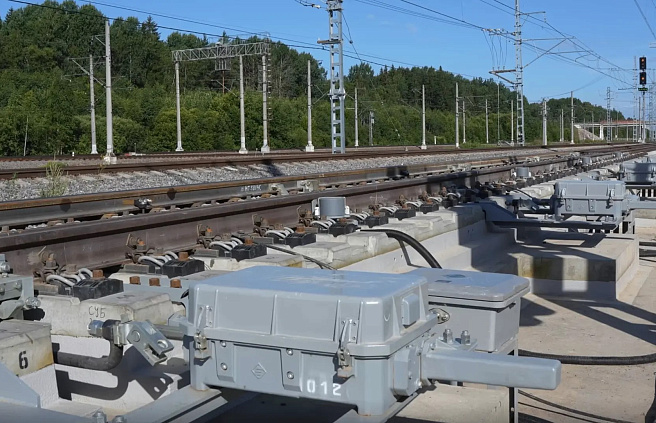
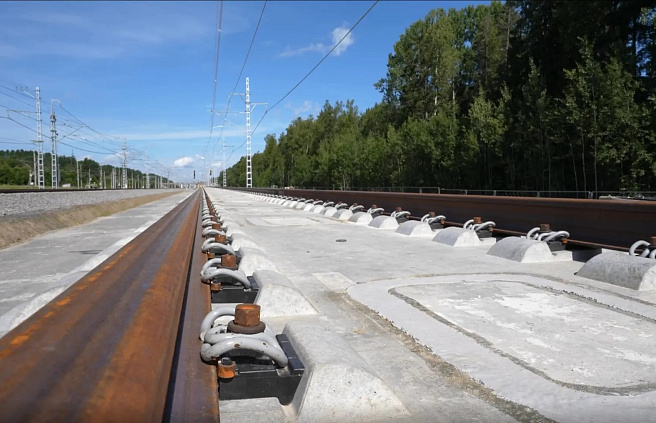
On the test section, the length of which is over one kilometre, Natsproektstroy specialists laid 207 NGP 4.0 track slabs and 56 turnout slabs. The installation of the slab track required high precision. Deviations in foundation height did not exceed 5 mm, and the position of each factory-made track slab was verified to within a millimetre. For this purpose, robotic total stations and proprietary software were used, which compares the actual position of structures with the design in real time and provides adjustment recommendations.
A major advantage of the Russian slab track over foreign solutions lies in the capability for rapid repair during operation. For this purpose, an elastic polymer is applied to the underside of the NGP 4.0 concrete slabs. The composite design allows track elements to be realigned in the event of subgrade settlement, and to be detached from the foundation for replacement. To demonstrate such operations on the Sablino – Tosno run, the builders carried out the adjustment of one track slab with the pouring of fast-setting, non‑shrink concrete. On the HSR, similar operations can be performed within the shortest night windows.
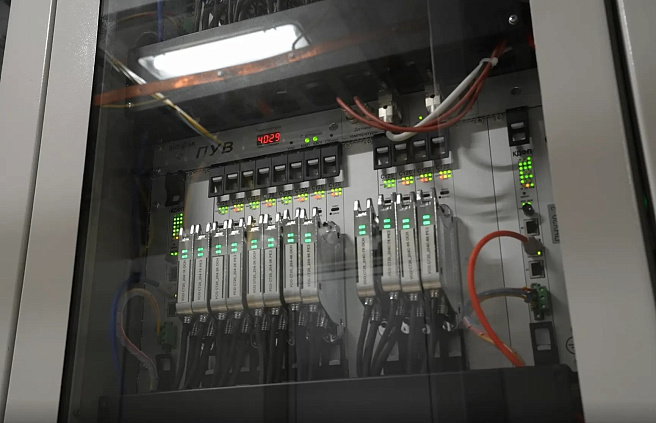
For the first time in Russia, innovative 1/25 turnouts designed for train speeds of up to 400 km/h on the main route and 120 km/h on diverging routes were installed at the testing site. The length of each is 118 metres, thus, a total of 8 innovative PV-EL electric actuators and 11 monitoring devices have to be used to operate it. Control is provided by a domestically developed hardware and software created by Elteza (a subsidiary of Russian Railway and part of Natsproektstroy Group). The system enables automatic and remote switching of turnouts, and continuous diagnostics of their condition.
The Sablino – Tosno testing site will be a key location for validating new engineering solutions before they are deployed on the first Moscow – St. Petersburg HSR. For this, over 1,500 sensors will be installed: underground, on above-ground structural elements, and on the Sapsan train.
A major advantage of the Russian slab track over foreign solutions lies in the capability for rapid repair during operation. For this purpose, an elastic polymer is applied to the underside of the NGP 4.0 concrete slabs. The composite design allows track elements to be realigned in the event of subgrade settlement, and to be detached from the foundation for replacement. To demonstrate such operations on the Sablino – Tosno run, the builders carried out the adjustment of one track slab with the pouring of fast-setting, non‑shrink concrete. On the HSR, similar operations can be performed within the shortest night windows.
For the first time in Russia, innovative 1/25 turnouts designed for train speeds of up to 400 km/h on the main route and 120 km/h on diverging routes were installed at the testing site. The length of each is 118 metres, thus, a total of 8 innovative PV-EL electric actuators and 11 monitoring devices have to be used to operate it. Control is provided by a domestically developed hardware and software created by Elteza (a subsidiary of Russian Railway and part of Natsproektstroy Group). The system enables automatic and remote switching of turnouts, and continuous diagnostics of their condition.
The Sablino – Tosno testing site will be a key location for validating new engineering solutions before they are deployed on the first Moscow – St. Petersburg HSR. For this, over 1,500 sensors will be installed: underground, on above-ground structural elements, and on the Sapsan train.


