Natsproektstroy at the session of Avtodor
The launch of the country's first Moscow–St. Petersburg High–Speed Railway Line will drive the growth of six constituent entities of the Russian Federation in many areas, including the training of skilled personnel and the development of production facilities. This was announced by Nikolai Russu, First Deputy CEO of Natsproektstroy for Production, during the session of the state-owned Avtodor Company at SPIEF 2026.
4 June 2026
Copy link
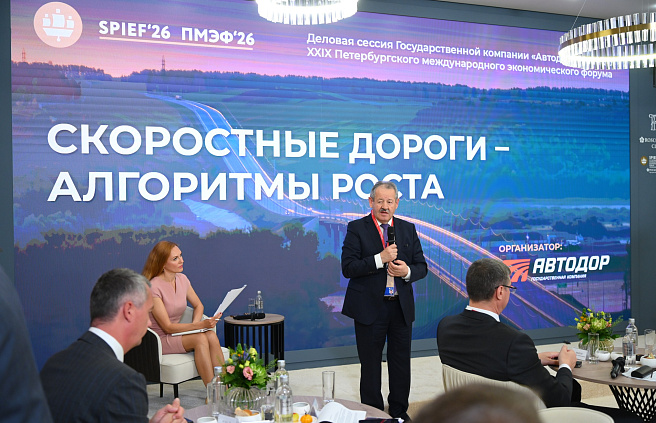
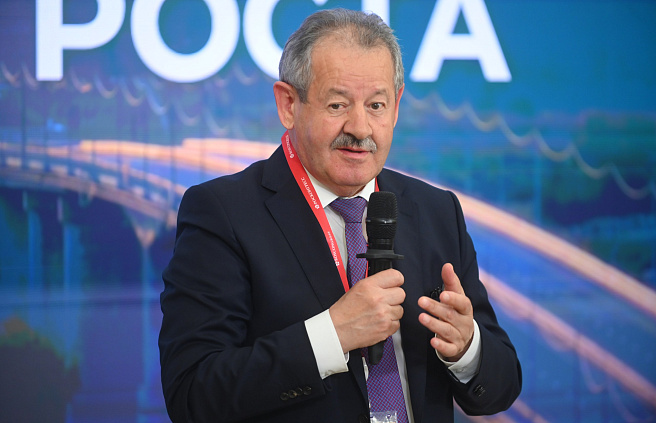
Domestic high-speed rolling stock and special rails are being designed to achieve the declared performance of the railway line – train speeds up to 400 km/h, wide temperature range. A whole range of technology is being created by Natsproektstroy, including an unparalleled ballast-free track design.
"Moscow – Saint Petersburg High–Speed Railway Line is the first, but far from the last, construction project of this level. That is why, we purchase expensive equipment, create technology and train personnel, and implement digital control. Many engineering solutions have never been used in our country, and we hope to replicate this experience in new projects for the development of high-speed railway service," said Nikolai Russu.
Railway line construction schedule is extremely tight. The assistance of regional authorities makes it possible to quickly resolve issues that arise during the deployment, including the land allocation, relocation of utilities, and the definition of transport layouts for special-purpose machinery.
A strong infrastructure cluster is being created in the regions along the high-speed railway line route. Two robot-aided plants will be opened in Veliky Novgorod and Likhoslavl this year to manufacture ballast-free rail slabs for high-speed railway lines. In Moscow, Tver, Novgorod, and Leningrad Regions, Natsproektstroy is equipping ten sites to produce 700-ton bridge beams, and 14 workshops to produce piles to strengthen the roadbed.
"Moscow – Saint Petersburg High–Speed Railway Line is the first, but far from the last, construction project of this level. That is why, we purchase expensive equipment, create technology and train personnel, and implement digital control. Many engineering solutions have never been used in our country, and we hope to replicate this experience in new projects for the development of high-speed railway service," said Nikolai Russu.
Railway line construction schedule is extremely tight. The assistance of regional authorities makes it possible to quickly resolve issues that arise during the deployment, including the land allocation, relocation of utilities, and the definition of transport layouts for special-purpose machinery.
A strong infrastructure cluster is being created in the regions along the high-speed railway line route. Two robot-aided plants will be opened in Veliky Novgorod and Likhoslavl this year to manufacture ballast-free rail slabs for high-speed railway lines. In Moscow, Tver, Novgorod, and Leningrad Regions, Natsproektstroy is equipping ten sites to produce 700-ton bridge beams, and 14 workshops to produce piles to strengthen the roadbed.


