For the first time in Russia, an unmanned compaction roller was put into operation by Natsproektstroy and GLONASS on the section of the Moscow–St. Petersburg High-Speed Railway
Russia's first fully autonomous road compaction roller has started operation on the section of the Moscow–St. Petersburg High-Speed Railway under construction. The unmanned vehicle is a joint design of Natsproektstroy Group and GLONASS JSC.
17 December 2025
Copy link
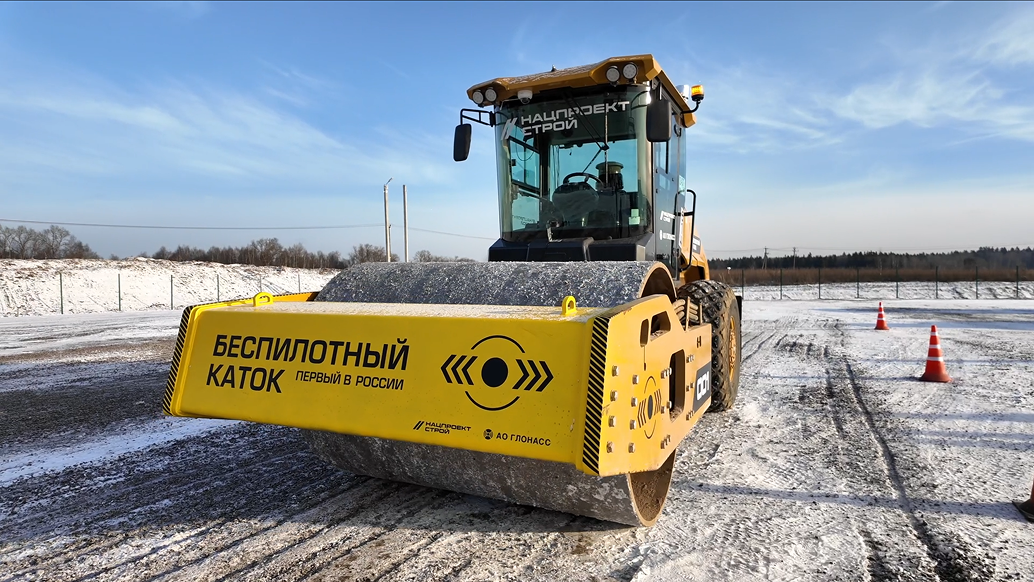
Russia's first fully autonomous road compaction roller has started operation on the section of the Moscow–St. Petersburg High-Speed Railway under construction. The unmanned vehicle is a joint design of Natsproektstroy Group and GLONASS JSC.
"The unmanned compaction roller project is not just a local experiment. The economic benefit that we saw during the tests proves the feasibility of serial implementation of the design. Next year, we plan to allocate a whole section where several such vehicles will build the road. In the future, we plan to create an autonomous dump truck-grader-roller bundle, which will automate the entire cycle of paving," said Andrey Sysuev, Deputy CEO for Information Technology at Natsproektstroy Group.
"We have created a domestic universal system of high-precision self-driving for road construction machinery based on an in-depth process analysis. Testing of this design solution in real conditions on the construction sites of such unique projects as the Moscow–Petersburg High-Speed Railway and earlier M-12 Vostok makes it possible to start mass implementation of unmanned technology faster. By automating heavy machinery that does more than 85% of the job, our solution closes a key segment of road construction. The system is installed in a few hours on any machinery, both Russian and foreign. And most importantly, we are implementing a fully Russian solution, independent of foreign vendors. Technological sovereignty will have a sustainable effect on the development of the entire industry," said Alexey Raikevich, CEO of GLONASS JSC.
Automation increases the speed of work, reduces the load on the operator, reduces the number of passes and optimizes fuel consumption, and reduces the risk of errors.
To create a work assignment for the compaction roller, the operator sets the required number of passes and the width via a mobile application from a tablet. The roller independently adjusts the trajectory and direction of travel, doing its job with centimeter accuracy and minimum tolerances. The operating perimeter of the machinery is monitored by an integrated safety system: it analyzes data from sensors, radars, lidars and cameras, and recognizes surrounding objects. Further development of the system will allow the operator to control several machines simultaneously.
The high-precision self-driving system has been designed based on an in-depth analysis of construction processes. The machinery is tested in real conditions, on different types of paving. The first phase of testing of the unmanned compaction roller took place in the summer of 2025 on the Dyurtyuli –Achit Section of M-12 Vostok Highway, which was built by NPS companies.
"The unmanned compaction roller project is not just a local experiment. The economic benefit that we saw during the tests proves the feasibility of serial implementation of the design. Next year, we plan to allocate a whole section where several such vehicles will build the road. In the future, we plan to create an autonomous dump truck-grader-roller bundle, which will automate the entire cycle of paving," said Andrey Sysuev, Deputy CEO for Information Technology at Natsproektstroy Group.
"We have created a domestic universal system of high-precision self-driving for road construction machinery based on an in-depth process analysis. Testing of this design solution in real conditions on the construction sites of such unique projects as the Moscow–Petersburg High-Speed Railway and earlier M-12 Vostok makes it possible to start mass implementation of unmanned technology faster. By automating heavy machinery that does more than 85% of the job, our solution closes a key segment of road construction. The system is installed in a few hours on any machinery, both Russian and foreign. And most importantly, we are implementing a fully Russian solution, independent of foreign vendors. Technological sovereignty will have a sustainable effect on the development of the entire industry," said Alexey Raikevich, CEO of GLONASS JSC.
Automation increases the speed of work, reduces the load on the operator, reduces the number of passes and optimizes fuel consumption, and reduces the risk of errors.
To create a work assignment for the compaction roller, the operator sets the required number of passes and the width via a mobile application from a tablet. The roller independently adjusts the trajectory and direction of travel, doing its job with centimeter accuracy and minimum tolerances. The operating perimeter of the machinery is monitored by an integrated safety system: it analyzes data from sensors, radars, lidars and cameras, and recognizes surrounding objects. Further development of the system will allow the operator to control several machines simultaneously.
The high-precision self-driving system has been designed based on an in-depth analysis of construction processes. The machinery is tested in real conditions, on different types of paving. The first phase of testing of the unmanned compaction roller took place in the summer of 2025 on the Dyurtyuli –Achit Section of M-12 Vostok Highway, which was built by NPS companies.


